Essential knowledge about brake systems, wheel hubs, and common problems — for safer and more confident riding.
Fundamental knowledge about wheel braking systems and how brake pads work
Brakes are the component responsible for slowing or stopping a vehicle — whether a car or motorcycle — according to the rider's will. The braking system is what controls the vehicle's speed, making "the brake system" the critical factor in safe riding control.
There are generally two types of brake systems: Drum Brakes and Disc Brakes.
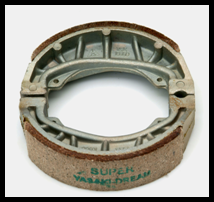
In a drum brake system, a cam pushes the brake shoes outward to make contact with and create friction against the inside of the wheel hub. The first brake shoe operates as the Leading Shoe — it makes contact first. The second shoe operates as the Trailing Shoe — it engages afterward, and provides less braking force than the first.
This operating principle tells us that the greater the contact surface area of the brake shoe, the shorter the braking distance and stopping speed will be.
Going back over 20 years, the market at the time favored Japanese products — "Made in Japan" was required to sell well. My father had a somewhat playful idea. Back then, Yamaha, Honda, and Kawasaki motorcycles were very popular. He combined them together and came up with the word "YASAKI." But in reality, it is a 100% Thai brand, fully registered as a trademark in Thailand.
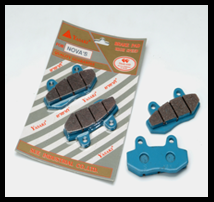
Our main market focus is brake shoes and disc brake pads. We also offer other motorcycle spare parts — front/rear wheel hubs, brake levers, clutch levers, mirror brackets, valve covers, clutch shoe bowls, etc. We also carry disc brakes for pickup trucks and passenger vehicles, though those haven't been heavily promoted yet. All of our products carry the YASAKI brand. We still also perform contract aluminum die-casting work to order.
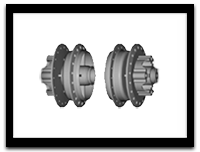
Consumer demands today are constantly shifting due to changing buyer behavior and the growing number of competitors in the market. In the past, parts were mostly used in their standard form from general-standard manufacturers. Today, parts such as wheel hubs and sprocket hubs are being machined to a polished finish, or wheels are being made from aluminum — all of which relate directly to safety. YASAKI products are manufactured as "standard parts", with every production step carefully supervised and inspected to provide maximum confidence to consumers, along with the widest model coverage available. You can be confident in the quality of YASAKI parts — "OEM-grade quality".
A collection of real-world usage problems, complete with causes and impacts you should know.
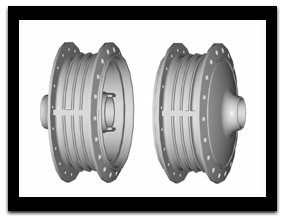
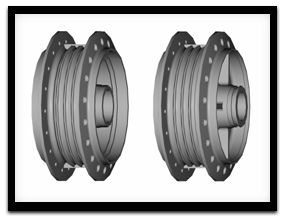
Wheel hubs are motorcycle components no less important than any other part. They are responsible for bearing the vehicle's weight and are directly related to the braking system, so they must be strong, durable, and resistant to deformation. YASAKI places great importance on close inspection at every stage of production. Hub problems can arise from non-standard manufacturing, poor-quality raw materials, or misaligned hub centers.
Common hub problems fall into two categories: assembly mechanic issues and end-user issues.
These problems recur when substandard parts are used. YASAKI has recognized the importance of these issues and controls every production step — using the same material grade as motorcycle manufacturers, forming with modern die-casting machines for consistent shape, CNC-turning for minimal deviation and high center precision, and using standard paint that won't peel or discolor under heat.
| Problem | Cause | Impact on Repair Shop |
|---|---|---|
| 1. Bearing housing cracks easily after bearing installation 2. Bearing becomes loose or wobbly after installation |
— Bearing housing diameter is non-standard (too small) — Inexperienced bearing installation technique — Bearing housing diameter is non-standard (too large) |
— Lost time and increased labor costs — Customers perceive the shop as having substandard workmanship |
| Spoke flange cracks or breaks when tensioning spokes — even with normal technique | — Non-standard raw material (aluminum alloy) used — Porous casting — too many air pockets in the part |
— Customers perceive the shop as lacking quality standards |
| After assembly and lacing, test spin reveals hub vibrates and wobbles significantly | — Left and right bearing hole centers are not aligned | — Customers perceive the product as substandard |
| Hub color changes from bronze to yellow after short use | — Manufacturer used low-quality, heat-resistant paint | — Product quality degrades quickly |
| Problem | Cause | Impact |
|---|---|---|
| Noise during braking — whether braking hard or lightly | — Brake pad compound composition — Brake shoe position is misaligned — Hub surface is rough or worn — Hub center position is off |
— Non-standard installation can also cause noise |
| Brakes don't grip — feel slippery, or pressing the brake feels like pressing a spring New brake pads fitted but slippery again after short use |
— Insufficient contact surface area — Ineffective brake pad compound — Not heat-resistant |
— Longer braking distance required |
| Brakes work fine when dry but slip when wet | — Low-quality brake pad compound | — Does not cover real-world usage conditions |
| Brake pads deeply groove the drum/disc surface | — Non-uniform brake pad compound mixture — Use of low-quality raw materials |
— Hub and disc wear out quickly |
" We are committed to developing comprehensive services — covering production, delivery, sales systems, and after-sales service that are fast and high-quality, with the widest possible coverage of motorcycle models. "— Sue Industrial Co., Ltd.